Food truck name generator and food truck name ideas generator that checks the .com on every name
A food truck name generator is only useful if the names it gives you can still be registered, because a truck lives on its website, its social handle and a phone search from the queue. This one writes food truck and food cart names from one line about your menu and checks every candidate against the domain registry before it shows it, so the shortlist is made of names you can claim today, before the wrap is printed.
| Builds | Names for food trucks, food carts, trailers and pop up kitchens, from your own brief |
| Checks | Every candidate against the domain registry before the row reaches your screen |
| Filters | Taken names dropped by default, so the shortlist is one you can act on |
| Returns | A value estimate on each free name, labeled as an estimate and not an offer |
No card to create the account. The tool below runs without one.
Run it on a brief like yours
The example below is already running against the real registry. Replace it with your own line and the model takes over from the local generator.
Availability is checked live against the registry. Your naming brief stays yours.
| Brief | Worked example, 148 characters |
| Style | Brandable, checking .com |
| Registry | RDAP, one live lookup per row |
| Progress | Starting the example 0 of 5 checked, free to register |
A worked example, running on the brief in the field. Write your own and the names come from the model instead of the fallback generator.
The example brief is being turned into names. Each one is then looked up against the registry that holds the record, and the verdict lands on the row.
On this page
- 01 Where a food truck name actually gets read
- 02 The festival line and the brewery event post
- 03 Office park lunch and private catering, where the buyer has a budget
- 04 The wrap and permit timeline decides when the name is final
- 05 What kind of food truck name still has a free .com
- 06 Food cart names and trailer names follow slightly different rules
Every plan is paid and starts at $39 a month. The tool above runs without an account.
Where a food truck name actually gets read
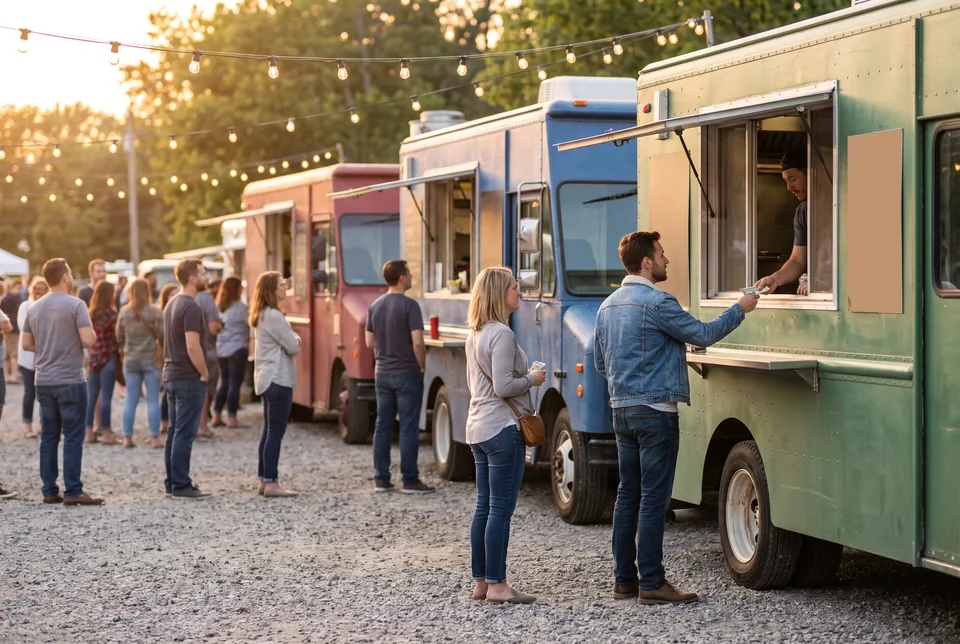
A storefront gets read by people walking past the same door every day. A truck gets read once, from about thirty feet away, by somebody standing in a line of twelve trucks at a festival or scrolling past you on a brewery's event post. That single glance is the whole job of the name, and it is why the rules for naming a truck are closer to the rules for a billboard than for a restaurant.
Most trucks earn their money on a circuit rather than a single spot. A typical week in a US city might be two weekday lunches at an office park, three or four evenings at brewery taprooms that do not run a kitchen, a festival or a farmers market on the weekend, and private catering booked through the website. Each stop reads the name differently, and a good candidate has to survive all four.
The festival line and the brewery event post
At a festival your truck is one panel in a row of panels, and people choose with their feet. The name has to say what you sell or pair with a picture that does, because nobody walks the length of the row twice. That is why the food truck names that work on a festival circuit are usually two words with the food in one of them, or a short brand word with a category line underneath it on the wrap.
At a brewery the name is read on a screen first. Taprooms post the week's truck lineup on social and on a chalkboard by the door, often as a list of names with nothing else, so a name that only makes sense with the artwork beside it disappears. Test each candidate as a plain line of text in a list of five other trucks. If the food is not obvious, add a clear category word or move on.
Office park lunch and private catering, where the buyer has a budget
The weekday lunch crowd wants speed and repeat visits, so the name has to be easy to say to a coworker ('the birria truck is here') and easy to find again on a map. A name that people shorten to a nickname is fine as long as the nickname is what you register as well.
Private catering is where a truck makes its best margins, and the buyer is a wedding planner, an HR team or a company booking an event, searching and comparing on a laptop. That buyer types your name into a browser. If the .com belongs to someone else, or to a truck in another state with the same name, the booking inquiry goes to the wrong inbox. This is the stop where the domain stops being optional, and it is the one the console on this page checks for you on every name before you see it.
If your catering side is growing into a sit down concept or a commissary kitchen with a counter, the brief changes. The restaurant name ideas page handles names for a full dining room, and the logic there about names that outgrow one menu applies to trucks that plan a second vehicle.
The wrap and permit timeline decides when the name is final
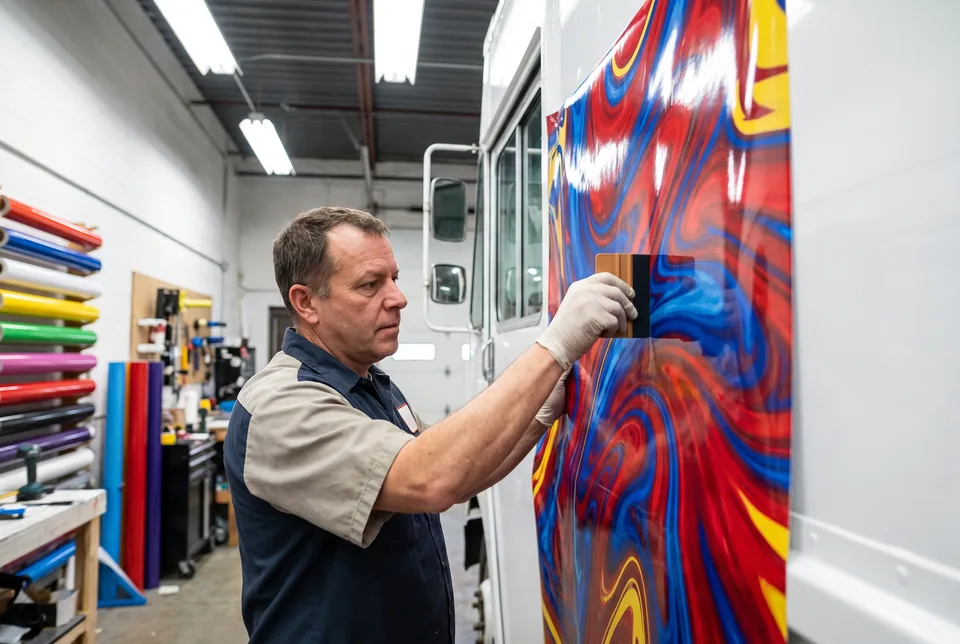
A truck name has a hard deadline that most businesses do not have, and it arrives earlier than people expect. The wrap is the most expensive printed item a truck owns, typically a four figure job, and the proof goes to print weeks before the truck works its first event. Rewrapping after a name change pays for that job twice.
The paperwork runs on the same clock. The business name goes on the mobile food vendor permit application with your county health department, on the commissary agreement, on the certificate of insurance that festivals and property managers ask for, and on event vendor applications that often close months ahead. Changing the name after those are filed means updating each one, and some organizers treat a renamed vendor as a new applicant.
So the practical order is to settle the name, claim the domain and the handles the same day, then send the wrap proof and file the permit. If the truck is owned through a new company, the entity name and the name on the side of the truck can differ, and our llc name generator is built for the legal name while this page handles the one customers read.
What kind of food truck name still has a free .com
Single words are gone. Taco, Birria, Smash, Crave and every obvious food word was registered long ago, usually by a domain investor rather than a truck. The combinations that still come back free follow a few patterns, and the generator leans on them by default.
The food plus a place or a person works well for a truck because it answers the festival question and the catering question at once, for example a dish paired with a neighborhood, a street or the owner's first name. A food plus a verb or a sound (sizzle, stack, drip) gives a lively name that still says what you sell. A short invented word works if the wrap carries the category line, and it is the pattern with the best odds of a free .com, but it asks more of your artwork.
Puns are the risky pattern. A good one gets photographed and shared; a strained one reads as a joke about your own food. The research we did for our food truck names article found that the puns which last are short and land on the dish itself, not on a pop culture reference that dates in a year. Whatever pattern you choose, the registry check comes first, because it removes more candidates in two seconds than every other test put together.
Each free name in the console also carries a value estimate. Use it as decision support when two finalists feel equally good, never as an offer or a promise of what the name would sell for.
Food cart names and trailer names follow slightly different rules
A cart or a small trailer has much less surface than a step van. The name often sits on an umbrella, a small header board and a menu sign, and it is read from closer range, so shorter wins. One or two short words, no tagline, and the food either in the name or on the board beside it.
Carts also tend to work fixed spots with permits tied to a location, which makes the name more local and more like a small storefront. Our coffee shop names page covers the pattern for a coffee cart or an espresso trailer, where the rules about cups and printed sleeves apply as much as the rules about the vehicle.
Be clear about what each check covers. NameBest checks the domain registry only. It does not search your Secretary of State entity register, your county's business name filings or the federal trademark record. Before the wrap proof is signed, run the finalists through a state entity search and a trademark search, and use our domain availability checker if you want to test a name you already have in mind rather than generate new ones.
Questions people ask first
The rest are on the FAQ, and the mechanics are in how it works.
Start with one line that says what you cook and where you sell it, then generate candidates and check the .com right away, because that removes most names in seconds. Read the survivors as plain text in a list of other trucks, picture them on the side panel from thirty feet, and take the last two or three to a state entity and trademark search before the wrap is printed.
A catchy food truck name is short, easy to say out loud in a queue, and makes the food obvious either in the name or with a category line on the wrap. Two words with the dish in one of them is the most reliable shape. It should also still be free as a .com, since catering clients and festival organizers will search for it.
Usually yes, or the wrap has to carry it for the name. People choose trucks at festivals in a single glance and breweries often list trucks as plain text, so a name that hides the food loses customers who never walk up. A brand word without the food works only if the category line on the truck and online is big and clear.
In most US states, yes, in some form. If the truck operates under a name other than your legal or company name, you usually file an assumed name or DBA with your state or county, and the name goes on your mobile vendor permit. Rules differ by state, so check with your Secretary of State and county. The domain is a separate registration that nobody files for you.
There are three separate records and none of them checks the others. The domain registry tells you whether the .com is free, which this generator checks live on every name it shows. Your state and county business filings tell you whether a local business already uses it. The federal trademark record covers wider commercial use. NameBest checks only the domain.
Close to this one
Three pages that answer the neighbouring question, each with the console seeded for its own kind of business.
Restaurant name ideas are easy to find and hard to use, because almost every list you read was written without checking whether the .com is still free. This restaurant name generator builds candidates from a line about your place and puts each one to the registry before the row appears, so what you read is what you can still register today.
Coffee shop names are the easiest thing in the world to brainstorm and the hardest to actually keep, because the good short ones went years ago and no list on the internet tells you which. This coffee shop name generator builds candidates from a line about your shop and puts every one to the domain registry before the row appears, so the shortlist you read is a shortlist you can register today.
Bakery names are easy to brainstorm and hard to keep, because the short warm words every baker reaches for were registered a long time ago and no list of bakery name ideas tells you which ones are gone. This bakery name generator writes candidates from one line about your bakery and checks every one against the domain registry before it shows it to you, so each name on the shortlist is one you can register today.
Write one line and see what survives the check.
Every name that comes back free has been looked up against the registry that holds the record. Nothing on the shortlist is already gone.
No card to create the account. Your brief stays yours.